
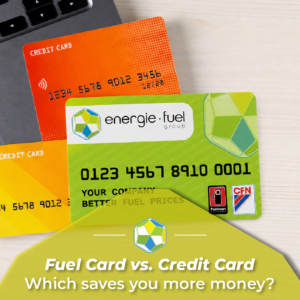
Business owners know their way around running their businesses and managing expenses. Most business owners are also familiar with business credit cards and how they separate business-related expenses from their own personal expenses. While credit cards offer convenience, wide acceptance, and reward points, business credit cards aren’t built specifically for fleets. Fuel cards (also commonly referred to as fleet cards) are specifically built to help businesses manage their fuel-related costs, but is there more to it? What can a fuel card offer that a business credit card simply cannot?
One of the main distinctions between a credit card and a fuel card is how they operate. A business credit card is still a money-lending tool, while a fuel card is a business payment tool. Your business won’t be borrowing money to cover fuel expenses. Instead the expenses are charged to your business bank account. A big draw of business credit cards are the rewards, points, and rebates. Fuel cards don’t offer points or flashy rewards. Instead, you get per-gallon fuel discounts and access to CFN stations, which offer wholesale fuel pricing. A standard business credit card will simply not guarantee access to wholesale fuel pricing.
Another big advantage fuel cards offer is better fuel management tools and reporting. With a business credit card, you will typically get access to the merchant’s name, date of purchase, and total amount of money spent. Fuel cards collect much more data to help you properly manage your fleet and all of your company’s fuel-related expenses. Everything from the merchant’s name, date of purchase, time, gallons, price, fuel type, driver name, vehicle number, and odometer reading are captured. This makes tracking fuel expenses across your entire fleet much easier and more efficient. Another thing fuel cards provide that credit cards do not are the ability to generate pre-IFTA (International Fuel Tax Agreement) reports and other reports needed for fuel and tax reporting.
For fleet managers, fuel cards provide more tools to control your fleet’s spending and prevent card misuse. Many fuel cards, including the Energie Fuel Card, offer a variety of card controls, such as fuel-type restrictions, daily transaction limits, and daily or monthly gallon limits. Fuel cards also allow you to set authorized fueling locations based on state and block ZIP codes if needed. You’re also able to set fueling times and days for each driver depending on their work hours.
When it comes to fraud, fuel card providers like Energie Fuel take the safety of businesses very seriously. The Energie Fuel Card monitors transactions daily through Corpay’s fraud protection system, which can identify unusual activity in real time. If activity falls outside normal patterns, the system will send an alert to your team and to Energie Fuel. Fuel card providers like Energie Fuel can also automatically block transactions based on tolerance levels customized to your account. Fuel cards truly go the extra mile when it comes to fraud protection because of how detailed fuel transaction information is recorded.
If you’re looking to save money on fuel and keep better track of your company’s fuel expenses, then a fuel card can be a much better option. Fuel cards can offer bigger fuel savings than a business credit card because they open up the ability to use CFN sites that offer wholesale fuel pricing. The Energie Fuel card also has no annual fee, no monthly fee, and no transaction fees. Not only that, but fuel cards are specifically designed to streamline and simplify fuel transactions and fuel-related reporting.
If possible, a combination of a fuel card and a business credit card can be ideal for both big and small businesses. Fuel cards can be used for all your fuel-related purchases, while a credit card can be used for other business expenses. Having both types of cards can be beneficial for tracking business expenses while also helping you get the most out of the benefits each card offers. Energie Fuel is here to empower businesses to make smarter fuel decisions and learn how they can better manage their fleets.