
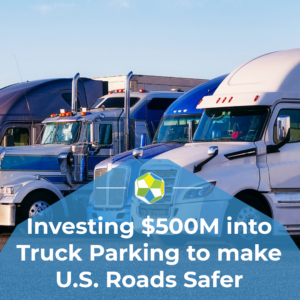
 There’s an ongoing issue that truckers across the United States are facing: the severe shortage of safe and accessible truck parking. While often overlooked, this problem has major implications not only for drivers, but for the entire supply chain.
Truck drivers operate under strict Hours of Service (HOS) regulations, which limit them to a maximum 14-hour work shift. Within that timeframe, they must complete all driving, loading, and unloading before taking a mandatory rest break. With the widespread use of Electronic Logging Devices (ELDs), these rules are enforced with precision, leaving little room for flexibility. Once a driver’s clock runs out, they are legally required to stop, whether or not safe parking is available nearby.
This creates a daily challenge: finding a secure place to park before time expires. Unfortunately, options are extremely limited. Approximately 80% of truck parking in the U.S. is privately owned, and at any given time, only about 9% of spaces are available. This shortage often forces drivers into unsafe situations, such as parking on highway shoulders or in unlit, unsecured areas.
The impact of this issue extends far beyond the driver. As Evan Shelley, CEO of Truck Parking Club, explains, “It costs everyone money if drivers don’t have an adequate place to park and are spending a lot of time looking for parking.” When drivers lose valuable time searching for parking or are forced to stop early to secure a spot, delivery schedules are disrupted, operational efficiency drops, and costs increase across the supply chain.
Recognizing the urgency of the issue, Congress has approved funding to expand truck parking infrastructure. Initial efforts are being rolled out in states like Florida, Ohio, and Tennessee, aiming to increase the number of safe, designated parking areas for drivers. These developments represent a step in the right direction toward addressing one of the most pressing safety concerns in the trucking industry.
However, meaningful change will take time. In the meantime, companies can take proactive steps to better support their drivers. Fuel cards, for example, help simplify one critical part of a driver’s journey. With access to over 65,000 card-accepting locations nationwide, drivers can plan routes more efficiently, refuel with ease, and reduce unnecessary stress on the road.
By improving efficiency and reducing friction, solutions like fuel cards contribute to safer operations, lower costs, and more reliable delivery timelines. The result is a win across the board: drivers stay safer, businesses stay competitive, and customers receive their goods on time.
As we continue to rely on truck drivers to keep goods moving across the country, it’s important to recognize the challenges they face and support solutions that improve their safety and quality of life.